.png)
Organic vs Paid Social Media: How to Choose the Right Strategy for Your Business
One of the first decisions founders face when investing in social media is whether to build an organic presence or start running paid campaigns.
The question often sounds simple: Should we spend money on ads, or should we focus on content first?
The answer is rarely one or the other.
For a growing business, Organic vs Paid Social Media is not really a choice between two competing strategies. They solve different problems. Organic content helps a business establish its voice, understand its audience and build familiarity. Paid social can then help that message reach more of the right people, faster.
The real question is whether the business is ready to make paid activity work.
A business with unclear positioning, inconsistent content and no follow-up process can spend heavily on advertising without fixing the underlying problem. On the other hand, a business with a clear message and content that already resonates with its audience may have a strong foundation for paid growth.
Why This Isn't an Either-Or Decision
Organic and paid social media operate differently, but they can strengthen each other.
Organic content gives a business a place to explain what it does, demonstrate expertise, answer customer questions and show how it thinks. Paid campaigns can then extend the reach of those messages beyond the existing audience.
LinkedIn's research provides a useful example. Its internal research found that members exposed to both organic and paid content were 61% more likely to convert than those exposed only to paid content. Further research cited by LinkedIn found a potential 14% lift from an organic and paid strategy compared with paid-only activity, alongside a potential 12% reduction in cost per conversion.
This does not mean every business will achieve the same numbers. It does show why treating paid and organic activity as completely separate systems can limit performance.
A strong organic presence creates familiarity. Paid media creates additional reach. Together, they can move people from recognition towards consideration and action.
This is also why a business should establish its broader social media direction before putting significant money behind campaigns. Our earlier article, Is Your Social Media Strategy Helping or Hurting Your Business Goals?, explores why social media needs clear objectives rather than simply becoming a schedule of regular posts.
What Organic Social Media Helps You Achieve
Organic social media is often underestimated because its results are not always immediate.
A useful post may receive modest reach but still introduce your brand to someone who later becomes a customer. A founder's perspective may not generate an enquiry on the day it is published, but it can help a prospect understand the company's expertise before they make contact.
The first role of organic content is therefore familiarity.
People become more comfortable with brands they repeatedly encounter and understand. Sprout Social found that 80% of consumers say brand familiarity makes them more likely to buy on social media.
Organic content also gives businesses something equally valuable: information.
When people comment, save, share or respond to different topics, businesses learn what their audience cares about. This information can improve future messaging, offers and campaigns.
That starts with understanding the audience properly. As discussed in Understanding Your Audience: The Foundation of Successful MSME Marketing, audience research, engagement patterns, surveys and competitor analysis can help businesses understand what their customers actually need.
Organic social media is therefore not simply a free alternative to advertising. It can act as a testing and learning environment.
LinkedIn similarly recommends building an organic presence, learning what resonates with the audience and then using paid promotion to extend the reach of stronger-performing content.
What Paid Social Media Helps You Achieve
Paid social solves a different problem: distribution.
Even strong content has limits when a business has a small following or needs to reach a new audience. Paid campaigns allow businesses to put specific messages in front of selected audiences based on factors such as location, interests, professional roles or other targeting signals.
This can be particularly useful when a business has a clear offer, a defined audience and a specific commercial objective.
For example, a company launching a new service may use organic content to explain the problem it solves, answer common questions and establish credibility. Once that message has been validated, paid campaigns can help introduce the offer to a larger relevant audience.
The important word here is validated.
Paid media can amplify a strong message, but it can also amplify a weak one.
If people do not understand your offer organically, increasing the advertising budget does not automatically make it clearer.
Signs Your Business Is Ready for Paid Ads
Paid social becomes more useful when the business already has some basic marketing foundations in place.
Your positioning should be clear enough that a new visitor can understand what you offer and who it is for.
Your social profiles should represent the brand properly.
Your website or landing page should provide a clear next step.
Most importantly, you should have a process for handling enquiries once they arrive.
Organic content can also provide an early indication of what your audience responds to.
This does not mean you need thousands of followers or viral posts. It means you have started to identify which problems, messages and formats generate meaningful interest.
At that point, paid advertising can become an accelerator rather than a substitute for strategy.
Signs You Should Wait Before Running Ads
There are also situations where increasing ad spend is unlikely to solve the real problem.
If your positioning keeps changing, your content appears only occasionally, or your audience is still unclear, paid campaigns may produce traffic without meaningful commercial results.
The same applies if your website or landing page is not ready to convert visitors, or if there is no system for following up with enquiries.
In these situations, the better decision may be to strengthen the foundation first.
Paid advertising should not be expected to fix a messaging problem, a weak offer or a broken conversion process.
A Practical Framework for Founders
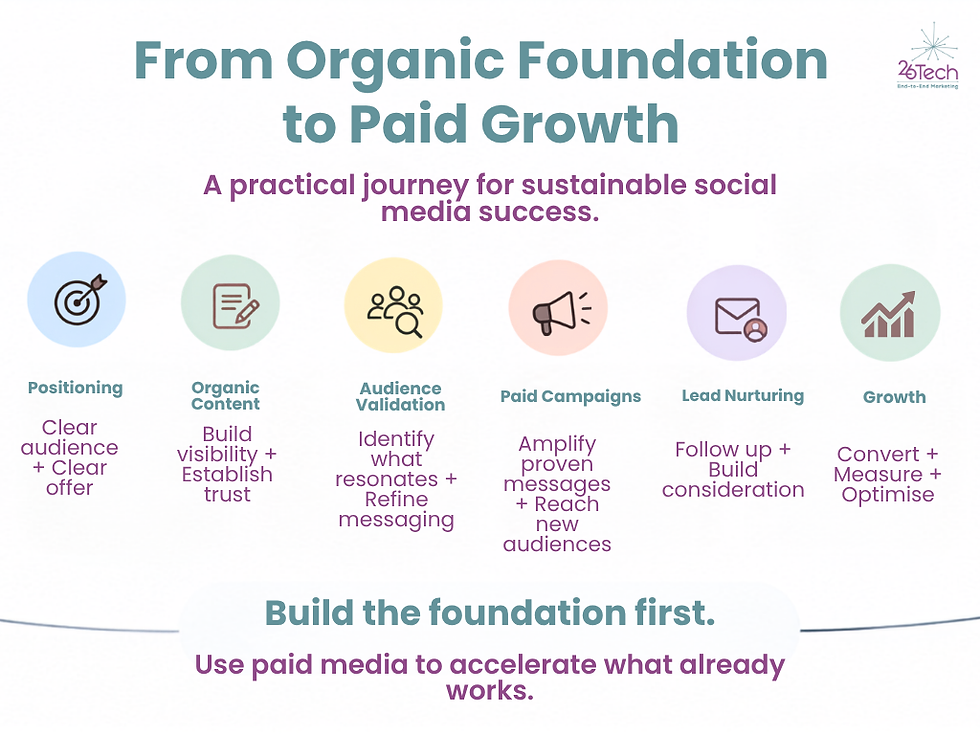
The most sustainable approach to Organic vs Paid Social Media is to let the two work in sequence while continuing to connect them.
Start by getting clear on your positioning and audience. Then build consistent organic content that communicates your value and gives you an opportunity to learn what resonates.
Once patterns become clearer, use paid campaigns to expand the reach of strong messages or promote specific offers.
From there, measure both sides together.
Organic performance can show which topics create interest and engagement. Paid performance can show how efficiently those messages reach new audiences and generate action. The combined picture is more useful than looking at either channel in isolation.
This approach is consistent with LinkedIn's broader guidance that businesses should build an organic presence, amplify relevant content through paid activity, and then measure and optimise the two together.
The same principle applies to lead conversion. Getting someone to click an ad is not the end of the process. They still need a relevant landing experience, timely follow-up and a clear path towards becoming a customer. Our Mastering Lead Conversion for Small
Businesses case study explores how content, multiple channels and a structured conversion process can work together to move leads towards a decision.
How Consumer Behaviour Is Changing
The distinction between organic and paid is becoming less visible from the customer's perspective.
A potential buyer may discover your brand through a paid advertisement, visit your profile, read several organic posts, watch a video and only then contact you.
Social media is increasingly part of the research process itself.
Sprout Social's 2025 research found that 37% of consumers use social media as their starting point for product research, while 76% said they had purchased something in the previous six months because of content they saw on social media.
That means your organic presence still matters even when the original visitor arrived through an advertisement.
The ad may create the first interaction. Your wider content ecosystem helps answer the question: “Can I trust this business?”
How 26Tech Can Help
At 26Tech, we help businesses decide when and how to combine organic and paid marketing, rather than recommending advertising simply because a budget is available.
We can help build the underlying marketing strategy, develop organic content that supports your positioning, identify messages worth amplifying, and create lead generation systems that give paid campaigns a clearer path to conversion.
The objective is to make your marketing investment work as one connected system.
If you're unsure whether your business is ready for paid social media or needs to strengthen its organic foundation first, book a 1:1 consultation to discuss your current marketing setup.
You can also subscribe to the 26Tech newsletter for practical insights on marketing strategy, content and growth.
FAQs
Q1: Should a new business start with organic or paid social media?
Most new businesses benefit from establishing a basic organic presence first. This helps clarify positioning, build credibility and understand audience response before significant advertising spend is introduced.
Q2: How long should I build an organic presence before running ads?
There is no fixed period. Readiness matters more than a specific number of weeks or months. If your message, offer, audience and conversion process are clear, paid campaigns can be introduced earlier.
Q3: Can paid ads work without regular social media content?
Yes, but the wider customer journey can become weaker. Someone who clicks an advertisement may visit your social profile before deciding whether to enquire. A credible organic presence can provide additional reassurance.
Q4:How much should a small business spend on paid social media?
There is no universal amount. Budget should depend on the value of a customer, the size of your audience, your conversion process and how much you can afford to test without putting pressure on the business.
Q5: Which platform is better for organic growth and which is better for paid advertising?
There is no universally better platform. The right choice depends on where your audience spends time and how they make purchasing decisions. Audience understanding should come before platform selection.
Q6:How do I know if my business is ready to invest in ads?
Look at the foundations first. You should have clear positioning, a defined audience, a strong offer, credible social profiles, a functioning conversion path and a process for following up with leads.
Conclusion
The Organic vs Paid Social Media debate becomes much easier when you stop treating them as competing choices.
Organic social media builds familiarity, credibility and audience understanding. Paid social media can extend reach, accelerate demand and bring specific offers to new audiences.
The strongest strategy connects both.
Build the foundation. Learn what resonates. Then use paid media to amplify what is already working.
For small businesses in particular, this approach reduces the risk of spending money simply to discover that the underlying message was never ready for scale. It gives every campaign a stronger foundation and helps marketing move from isolated activity towards a system that supports sustainable growth.


Comments